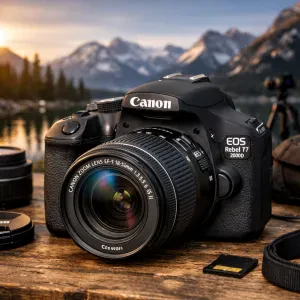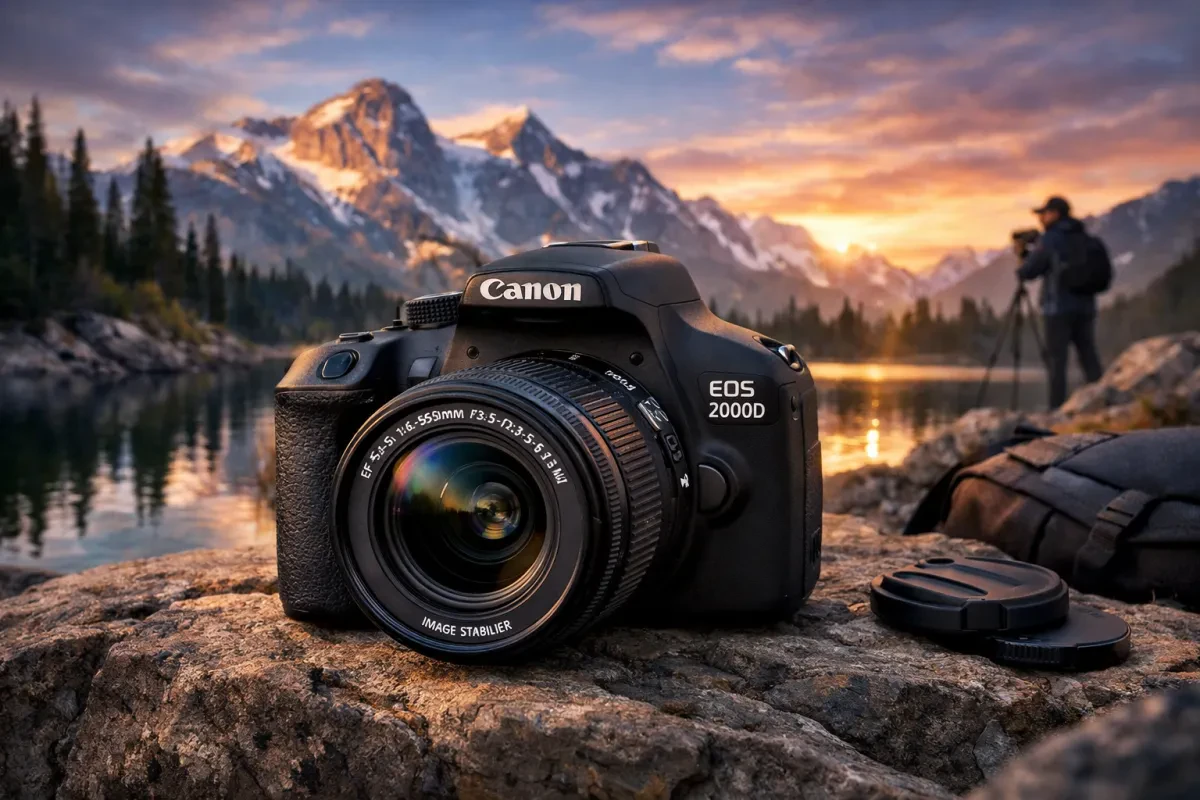
The Canon EOS 2000D, also known as the Digital Rebel T7 in North America, is an entry-level DSLR that aims to attract first-time buyers looking to dive into interchangeable lens photography. As the successor to the EOS 1300D, it brings a few notable upgrades, primarily the new 24.1-megapixel sensor, a slight bump from its predecessor's 18-megapixel offerings. But don’t get too excited; many features remain the same, keeping it more of an evolutionary step than a revolutionary one.
Design & Build Quality
At first glance, the Canon EOS 2000D looks almost identical to the 1300D. It measures 129mm wide, 101.3mm high, and 77.6mm deep, with a weight that’s just a whisper lighter at 475 grams. This slight difference in weight won't make a significant impact on your shooting experience. The build quality feels solid, but you won’t find weather sealing here, which is standard for entry-level DSLRs.
The camera is ergonomic, featuring a good rear thumb rest and intuitively placed buttons. However, if you have larger hands, you might find the finger recess a tad shallow, making it a bit less comfortable to hold. Overall, it’s easy to maneuver thanks to well-placed controls like the dedicated ISO and white balance buttons, which are often missing in competing models.
Ease of Use
For anyone stepping into the world of DSLRs, the Canon EOS 2000D excels in user-friendliness. Its layout remains intuitive, with dedicated buttons for key settings. Accessing the quick-control menu is a breeze, letting you quickly adjust things like exposure compensation and shooting modes without getting lost in complicated menus.
- Quick-access menu to tweak settings effortlessly
- Dedicated ISO and white balance buttons not found on some competitors
- Comprehensive main menu with well-organized tabs
The mode dial features various presets for different shooting scenarios, which could be helpful for beginners. Still, you might find some modes less useful as you grow in your photography journey. Overall, it’s nice to see a camera aimed at newcomers that doesn’t shy away from offering decent control options.
Image Quality
The EOS 2000D impresses with its image quality, particularly in good lighting. You can expect vibrant, noise-free images at ISO settings up to 800, with some noise creeping in at 1600. Going beyond that, like to ISO 6400 or 12800, is generally not recommended unless you're in a pinch. The built-in pop-up flash does a decent job for indoor shots, which can be a lifesaver if you're just starting out in photography.
- Good performance up to ISO 800
- Images retain quality even at higher settings, but avoid maxing out ISO
- Solid low-light performance with a maximum shutter speed of 30 seconds for night shots
Video Performance
When it comes to video, the EOS 2000D records Full HD at 30fps, which sounds good but falls short compared to competitors that offer higher frame rates. While it has a Video Snapshot feature to compile short video clips into a montage, serious videographers might want to look elsewhere, as it lacks 4K capabilities.
Connectivity Options
The camera includes built-in Wi-Fi and NFC pairing, making it easy to share your photos directly from the camera to your mobile device. Setting up a connection is quick and straightforward, and remote control options allow you to capture shots right from your smartphone, which is a fun perk for casual photographers.
Conclusion: Is It Worth It?
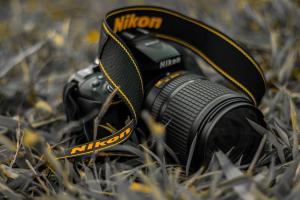
The Canon EOS 2000D is a solid choice for beginners who want an easy-to-use DSLR without breaking the bank. It’s user-friendly, produces quality images, and has decent connectivity options. However, if you’re looking to invest in something that outperforms its competition in terms of video and battery life, you might want to give the Nikon D3400 a look.
For those who are stepping up from smartphone photography, the EOS 2000D offers a reliable path to better image quality and creative control, albeit without many groundbreaking new features. It's a good starter camera, especially for its price point, which ranges around £369.99 for the body alone, or £469.99 with the EF-S 18-55mm lens kit. So, if you're set to start your photography journey, this camera won't disappoint!